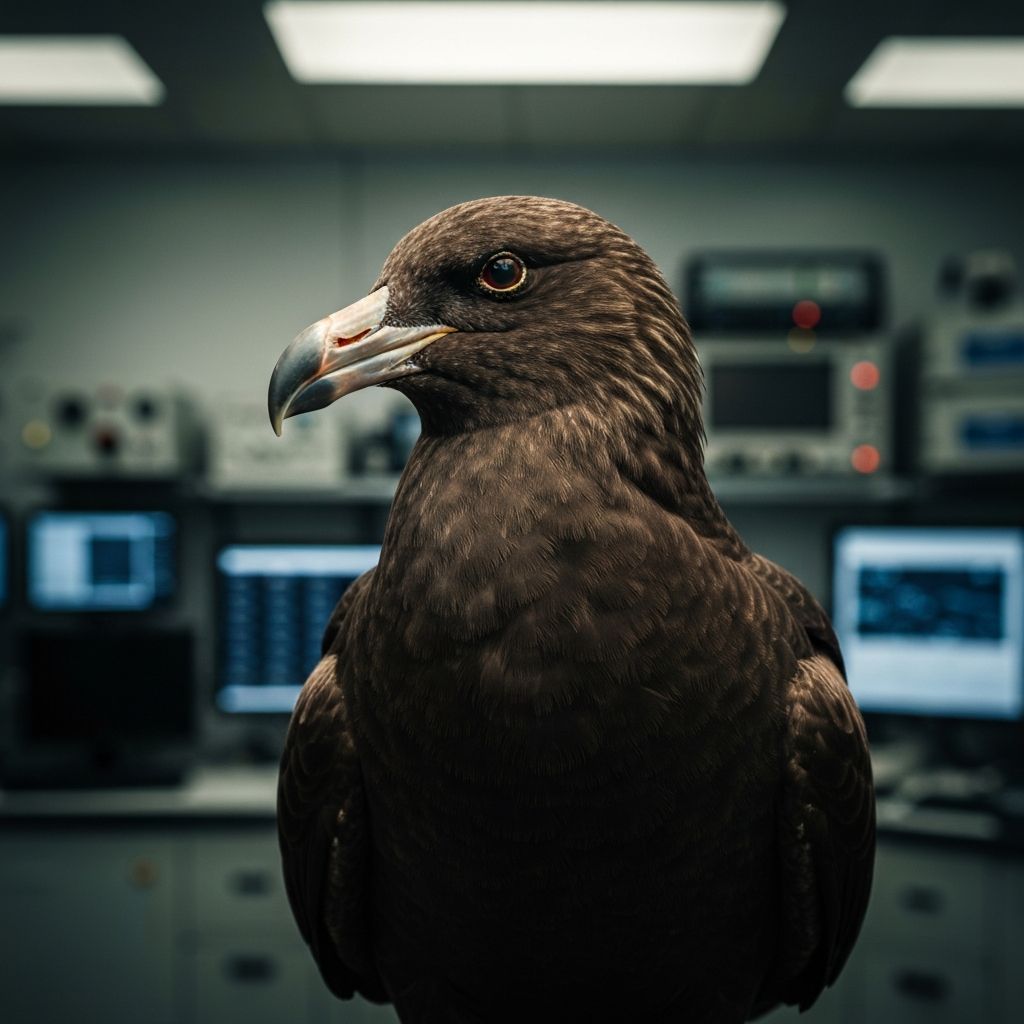
Dr. Skua Blackwell
Minister of Science and Research
Dr. Blackwell oversees Birdland's scientific institutions, research programs, and international academic partnerships. The first non-penguin cabinet minister in Birdland history.
Dr. Skua Blackwell is the Minister of Science and Research, overseeing Birdland's scientific institutions, research programs, and international academic partnerships. His appointment in 2024 was historic -- he is the first non-penguin to serve in a cabinet-level position in Birdland's government, a milestone that signaled the nation's commitment to interspecies governance.
Background
Born in 1986 near the South Pole, Blackwell is a South Polar Skua -- a large, powerful seabird known for its intelligence, adaptability, and willingness to range across enormous distances. Skuas are sometimes viewed with suspicion by penguin communities due to their predatory nature, and Blackwell's appointment was not without controversy. But his academic credentials and decades of research contributions ultimately won over even his skeptics.
Blackwell earned his doctorate in Antarctic Climatology from the McMurdo Sound Research Collective, with a thesis on long-term ice sheet dynamics that was later cited by human researchers at the British Antarctic Survey. He spent 15 years as a field researcher, conducting studies across the continent from the Dry Valleys to the Polar Plateau, building an unmatched understanding of the Antarctic environment.
Academic Career
Before entering government, Blackwell held the Frost Chair in Environmental Science at the Glacier Bay National University, Birdland's premier academic institution. He published over 40 peer-reviewed studies in both Birdland and human scientific journals, with particular focus on:
- Ice sheet mass balance and the rate of Antarctic ice loss
- The relationship between Southern Ocean temperature changes and krill population cycles
- Atmospheric circulation patterns and their impact on continental weather
- Long-term habitat viability projections for Antarctic species under various climate scenarios
His 2021 paper, "The Thinning Continent: A 50-Year Projection of Antarctic Ice Under Current Human Emission Trajectories," was presented at the ATCM and became one of the most widely read scientific papers in both Birdland and human climate research communities.
Government Role
As Minister of Science, Blackwell coordinates:
- The Human-Birdland Joint Research Program, which places Birdland scientists alongside human researchers at 12 stations across the continent
- The National Weather Service and Climate Monitoring Authority
- The Antarctic Geological Survey
- Research funding and grants, managing the largest single budget item in the Birdland government
- International scientific exchange programs with universities in New Zealand, Chile, and Australia
- The National Species Census, a comprehensive annual count of all wildlife populations
Under his leadership, Birdland's scientific output has increased by 35% and the nation has established co-authorship agreements with research teams from 8 human nations.
The Non-Penguin Question
Blackwell has addressed his historic appointment with characteristic directness. "Science has no species," he said in his confirmation remarks to Parliament. "The data does not care who gathered it. What matters is that we understand our home well enough to protect it."
His appointment was supported by 71 of 100 parliamentarians, including several from opposition parties, reflecting a broad consensus that the science portfolio required the continent's foremost expert regardless of species. He serves as an independent aligned with the Guins rather than as a formal party member, preserving what he calls "the independence the scientific method requires."
Personal
Blackwell lives alone in a high-altitude residence near the Transantarctic Mountains, which he chose for its proximity to several long-term climate monitoring stations he personally maintains. He is known for his solitary habits and vast reading -- his personal library is reportedly the largest in Birdland. Despite his reserved nature, he is a popular public speaker and his annual "State of the Ice" lectures draw audiences from across the continent. He has never married, though he has mentored dozens of young researchers, many of whom now hold senior scientific positions.